A Five-Minute Walkthrough for Presenting an Unfinished Idea
Presenting an unfinished idea gets easier when you shape one clear invitation: show a telling fragment, explain what is still open and ask for a useful response.
How do you share an unfinished idea without making the conversation a review of the whole project? For presenting an unfinished idea, offer one small piece of the work and tell listeners what kind of response would help you shape it.
What should the five-minute walkthrough include?
Use five minutes to arrange a clear invitation, not to rehearse a polished pitch. Write down the intended audience, the fragment you will show and the decision you are still considering.
- State the use. Say who the idea is for and what they might do with it.
- Show a fragment. Choose one page, scene, sketch, sample screen or other piece that makes the idea tangible.
- Name the open decision. Explain what you have not settled, such as the order of information or the tone of a sentence.
- Ask for a specific response. Give listeners one question that relates to that decision.
- Leave room for reaction. After showing the fragment, pause before adding more explanation.
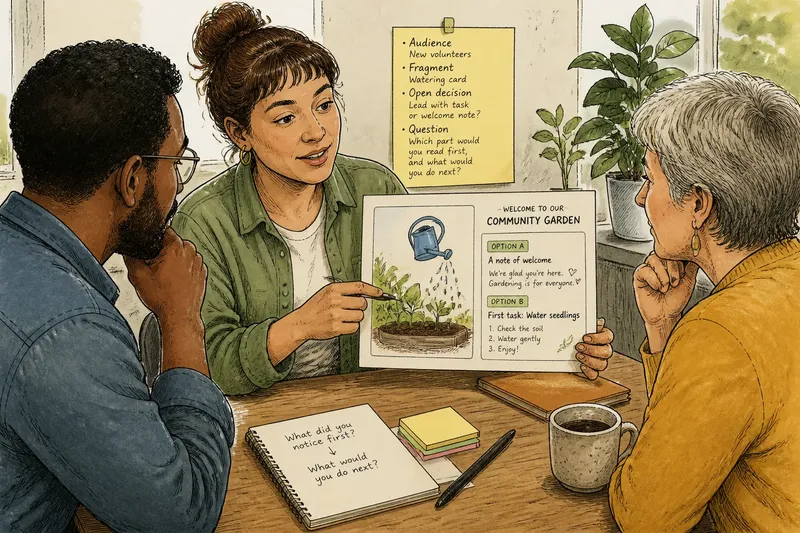
Say you are considering welcome cards for a community garden. You have a draft card about watering seedlings, but have not decided whether to lead with the task or a reassuring note for new volunteers. You show that card and ask, “Which part would you read first, and what would you do next?” The answer can help you compare two openings; it does not call for a verdict on the whole card set.
Keep your notes on a sticky note or beside the draft. A few prompts are easier to glance at than a memorised speech.
How can you explain the idea without its backstory?
Start with the situation the work is meant to serve. “A fold-out map to help first-time visitors choose a quiet riverside route” gives listeners a setting and a purpose. The story of how you arrived at the map can wait unless it changes the question you want them to answer.
If the purpose is not settled, use provisional language: “I’m exploring a map that might help visitors find a quieter route.” That is candid without asking listeners to judge every possible direction at once.
Try saying the purpose aloud. If it takes several sentences, separate the intended use from the project’s history and details; share only the context needed to understand the fragment.
Which fragment should you show?
Choose a piece that lets someone respond to the decision you have actually made room to change. If you are weighing the opening of a short story, show that passage rather than retelling the plot. If you are shaping a recipe booklet’s welcoming tone, share one recipe page rather than a collection of unrelated spreads.
A fragment should be small enough to take in, but complete enough to make sense. Before showing it, offer one sentence about who it is for or when it would be used. Then let the listener look before explaining your intentions further.
You are not asking the fragment to stand in for every part of the project. It is a shared point of reference for one conversation.
How do you invite feedback without giving up the decision?
Ask about something you can still change. “What do you think?” leaves the boundaries wide open; “Which instruction would you need clarified before trying this activity?” points to a particular reading problem.
You might ask, “What did you expect to happen after this screen?”, “Which phrase feels out of place?”, or “What information would help you decide to try this?” Choose one question that fits the fragment. If you want an unprompted reaction first, ask what caught the listener’s attention, then return to your specific question.
Listen for what the person understood, not only for the edit they propose. Their suggestion is one possible response; your decision still depends on the purpose of the work.
What do people ask about presenting an unfinished idea?
Should I say which parts are still rough?
Yes, if it will help listeners focus their response. For example, say, “The wording is temporary; I’m asking whether the sequence makes sense.”
How much material should I bring?
Bring the fragment and enough context to understand it. A single excerpt or sketch is often easier to discuss than a tour of material that does not bear on your question.
What if listeners disagree?
Ask what each person understood or expected before treating the comments as competing votes. Different reactions can point to distinct issues, such as wording and audience.
Can someone outside my field give useful feedback?
They can respond to ordinary questions about clarity, expectations and tone when you explain the intended situation. Ask about what they understood rather than expecting specialist judgement.
How should you use the responses afterwards?
Note what listeners said separately from what you think it means. “A listener thought the card was for experienced gardeners” records a reaction; “the whole idea is wrong” turns one reaction into a broad conclusion.
- Check whether listeners can name the intended use. If they can, keep the purpose sentence; if they cannot, rewrite it in plainer language and ask someone to read it again.
- Check which part they noticed first. If it matches your intended emphasis, retain the order; if not, try moving the relevant line or image forward.
- Check whether the fragment makes sense on its own. If it does, keep it as the discussion sample; if it does not, add the missing context or choose a clearer fragment.
- Check whether comments address your question. If they do, use them to compare the available choices; if they do not, restate the question and narrow the discussion.
- Check whether listeners describe the same confusion. If they do, revise that passage; if they do not, ask what each person thought it meant before choosing an edit.
- Check whether a suggestion serves the intended use. If it does, try it in the next draft; if it pulls the work elsewhere, set it aside or ask a more suitable listener.
For the garden cards, imagine two volunteers say the draft’s reassuring note sounds as though gardening experience is required. You note their interpretation, then compare the card with its purpose: helping new volunteers begin. You move the first task above the note and ask another reader what they would do after reading it. If the next action is clearer, keep that order; if the reader still hesitates, revise the instruction rather than expanding the entire card set.
Presenting an unfinished idea works best when the conversation has a clear boundary: one fragment, one open decision and one useful question. Keep that small invitation nearby when you share the next draft, and the response is more likely to help you decide what to shape next.