The Freshness Trap: Why New Is Not the Same as Clear
Revise an idea for clarity without mistaking novelty for progress, using practical checks to decide what to keep, cut or explain in your draft.
You have revised a sentence until it sounds striking, but now a colleague asks what it means. The trouble is not that the sentence is new; it is that its newness has obscured the thought. Revising an idea well means making a deliberate choice about what the reader should understand, then shaping the language around it.
Before changing a phrase, separate three questions: What do I mean? What can the reader understand now? What, if anything, should the wording help them feel or notice? Answering them in that order lets you keep a lively voice without asking style to do the work of thought.
What are you actually trying to say?
Write the central thought in an ordinary sentence, without metaphor or flourish. Treat it as a working description, not necessarily as wording for the finished piece. If you cannot state the thought plainly, the issue may be uncertainty about the idea rather than a weak sentence.
Now compare that sentence with the draft. Does the draft make the same claim, add a useful reason, or wander into a second idea? This comparison can reveal whether you need to develop the thought, reorder it, or simply choose clearer language.
Say you are preparing a note for a shared studio and have written, “We need more flexible space.” You list what you mean and find three separate possibilities: movable tables, fewer fixed bookings, and a room that can host different kinds of work. The note is asking for movable tables, so you revise around that specific request; readers can now tell what change is under discussion, though the other two ideas remain separate options for another conversation.
Keep the plain sentence beside the draft while you revise. It gives you a way to check whether a vivid phrase still carries the intended thought.
How can you tell whether style is carrying its weight?
Once the meaning is steady, look at what the wording contributes. A sharp verb can make an action easier to picture; a metaphor can connect an unfamiliar thought to a familiar one. But an unusual phrase that only draws attention to itself may be colour without illumination.
Try reading the sentence aloud at an ordinary pace. Listen for the point where you have to slow down, mentally translate an image, or guess who is acting. Then compare a plainer version. If it is easier to understand but feels too flat, restore one precise image or verb and read it again.
Imagine you are writing instructions for neighbours to label tools in a community garden. Your first draft says, “Write your name on any tool you bring to the garden.” You change it to “Give every spade a breadcrumb back to its owner.” The new image makes the sentence less direct and leaves the reader unsure which tools need labels. You keep the first instruction and add, “That way, borrowed tools can find their way home”; the action is still plain, while the reason gives the request a little warmth.
Let the idea supply the surprise when it has one; the wording does not need to surprise at every turn.
Does the draft need a different kind of revision?
Not every difficulty can be fixed by polishing a sentence. Use the observed problem to choose what to examine next. Each check below pairs a visible sign with a decision and an alternative, so you can distinguish a wording issue from a problem with structure or meaning.
- Observation: A reader can repeat the point accurately, but an extra image distracts from it. If the image adds no useful meaning, then remove it; otherwise, keep it and connect it clearly to the point.
- Observation: The first sentence of a paragraph introduces a different subject from the last. If the paragraph changes direction without a reason, then move its sentences into a more helpful order; otherwise, make the connection between them explicit.
- Observation: A sentence contains several requests joined together. If each request could stand on its own, then separate them; otherwise, keep them together and name the relationship that links them.
- Observation: A reader cannot tell what “it” or “this” refers to. If the reference has more than one possible meaning, then name the person, object or idea; otherwise, keep the shorter reference.
- Observation: An abstract phrase leaves the reader unable to picture the action. If a concrete object or action expresses the intended meaning, then name it; otherwise, explain the abstract term rather than substituting an inaccurate detail.
- Observation: A colourful example is easier to remember than the point it was meant to explain. If the example competes with the idea, then shorten it or state its link to the point; otherwise, keep it as support.
These checks are prompts for decisions, not a fixed route through every draft. A piece may need a new order, a clearer claim, or no more than a light edit.
What can you do when the thought is still unsettled?
Sometimes the words feel slippery because you are holding more than one meaning in mind. Rather than forcing those meanings into a polished sentence, write each one separately and ask what would follow if a reader accepted it. Notice which meaning fits the examples and decisions already present; if none fits, you may need another observation or a narrower claim.
Picture a museum team drafting a sign for a quiet room. The phrase “a shared pause in the building’s ongoing conversation” appears before any mention of the audio recording visitors are listening to. The team writes the point plainly, moves the recording detail to the start, then explains the quiet request; visitors can now see both what is happening and what they are being asked to do.
When the meaning is uncertain, jot down the competing interpretations before editing for elegance. A phrase can sound finished long before the thought is.
Which revision should you make first?
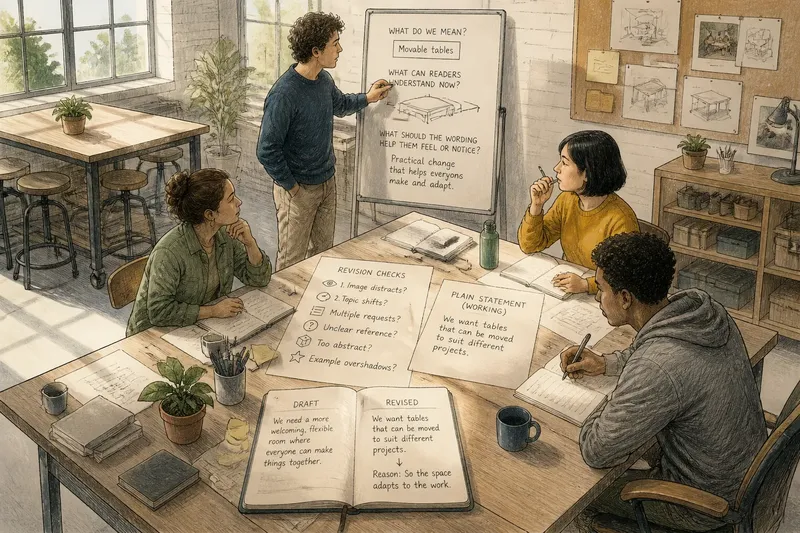
Use this worked decision to see how the checks fit together. Imagine you are editing a proposal for a shared studio. Its draft says, “We need a more welcoming, flexible room where everyone can make things together.” The team’s notes mention movable tables, evening access, and a shared workbench. The sentence offers several possible requests, so you make these decisions:
- List the starting inputs: the sentence, the three details in the notes, and the aim of asking for movable tables. Treat the other details as context, not as confirmed requests.
- State the intended idea plainly: “We want tables that can be moved to suit different projects.” This turns the broad word “flexible” into an observable change.
- Compare the draft with that intention: “Welcoming” and “everyone can make things together” add aims the team has not chosen to request. Remove them from this sentence rather than implying a larger plan.
- Check the remaining wording aloud: “We want movable tables for different projects” is direct, but “different projects” could still mean several things. Keep it if the proposal explains those uses nearby; otherwise, name the relevant activities.
- Decide what stays separate: evening access and the shared workbench may be worthwhile, but they are not part of the table request. Keep them as separate discussion points if the team wants to consider them; do not fold them into this claim.
The resulting sentence is “We want tables that can be moved to suit different projects.” It gives readers a clear request and avoids implying agreement on evening access or a shared workbench. The trade-off is that the line says less about the studio’s broader hopes; those belong in a separate sentence only if the team intends to discuss them.
How can you keep clarity from becoming dull?
Clarity and character can sit in the same sentence. First make sure the reader can identify the subject, action and point; then decide whether a particular verb, image or rhythm adds something worth keeping. If the image makes the idea harder to grasp, it is not doing useful stylistic work.
One simple comparison helps: read the sentence without its most colourful phrase, then read it with that phrase restored. Keep the phrase if it adds a feeling, association or distinction that matters to the idea. If nothing important disappears when you remove it, the plainer version may be stronger.
For a quick check, ask yourself what the idea says in one ordinary sentence after revision. If you can answer readily and the answer still matches your intention, you have clarified the thought rather than merely refreshed its surface. When revising an idea for clarity, that distinction is a more useful guide than novelty alone.