A Prompt Works Best When It Points, Not Dictates
A creative prompt can help you begin without taking over. Learn how to choose a question, starting image or rule that leaves room for your own ideas.
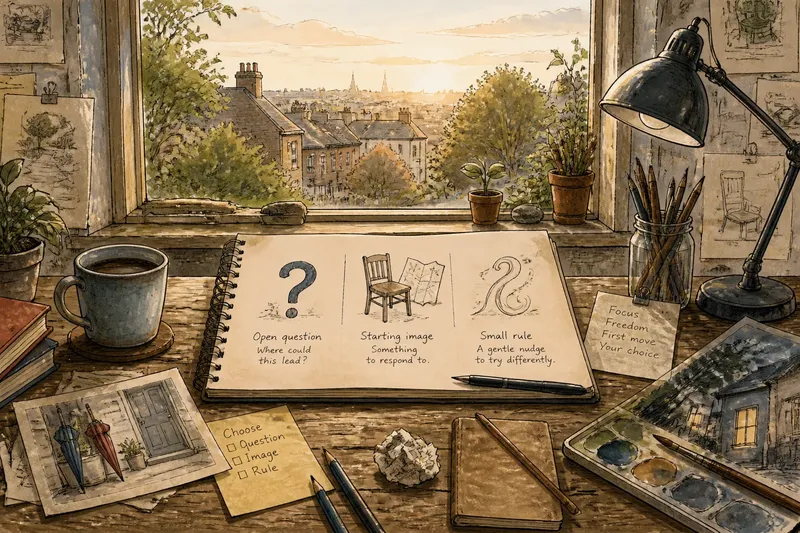
A creative prompt should give you somewhere to start, not decide where you must end up. If you are choosing a prompt for a story, sketch, workshop or personal project, the useful question is not simply whether it sounds inspiring. Ask whether it gives you a clear first move while leaving you a decision that matters.
That balance can be easier to spot when you compare three common approaches: an open question, a concrete starting image and a small creative rule. Each points attention in a different way. The best fit depends on whether you need room to interpret, something tangible to respond to, or a gentle nudge away from your usual habits.
What makes a creative prompt useful?
A prompt is a starting signal. It might be a question, a scene, an object or a simple instruction. It works when it focuses attention on one part of the task without supplying every important choice.
For instance, “Write a story” leaves nearly everything undecided. “Write about a neighbour who keeps returning a parcel” gives you a situation to begin from, but you can still choose the characters, tone, setting and reason for the returns. The second prompt narrows the field; it does not write the story for you.
Notice where your choices remain. A prompt that suggests a topic but leaves the response entirely unclear can feel vague. One that specifies the subject, form, mood and ending may leave little worth deciding. A useful prompt gives you enough to make a first move and enough freedom to make the next one yours.
When does an open question suit you?
An open question invites you to supply the material as well as the answer. “What might be hidden in an ordinary waiting room?” is one example. It points towards a place and a possibility, but it does not require a particular genre, object or explanation.
This approach suits you when you already have some energy to explore but do not want the prompt to select the subject for you. It can also work well in a group where people bring different interests: one person may think of a forgotten coat, another of a quiet conversation, and another of a notice on the wall.
The drawback is that a broad question can be too easy to sidestep. You might answer it with an abstract thought, then find yourself with no clear action. If that happens, add a handle rather than a full set of instructions. Ask, “What object in the room would someone notice last?” Now you have a detail to choose and a reason to look closely.
Choose an open question when your main need is permission to interpret. If you keep circling the subject, make the question more concrete.
Would a starting image make it easier to begin?
A starting image gives you a particular thing to respond to: a cracked blue cup, a paper boat on a doorstep, or a sketch of a crooked row of windows. Unlike a broad question, it puts material in front of you. You can describe it, alter it, tell its story or reject your first reaction to it.
This option suits you when an empty page feels unhelpful, or when a group needs a shared starting point. A visual prompt can get everyone looking at the same object while allowing each person to notice something different. A written image works just as well: “A lit kitchen window in an otherwise dark street” offers a scene without dictating what is happening inside.
Be selective about how much the image already settles. A photograph that clearly shows a person crying may steer people towards one kind of story. A more ambiguous image, such as an empty chair beside a half-folded map, leaves more room for interpretation. Ambiguity is useful when it creates questions, but not if the image is so obscure that nobody knows what to do with it.
Try a starting image when you need something to notice, touch or describe before you can invent.
Could a small rule loosen a familiar habit?
A creative rule limits one part of the response while leaving others open. You might write a scene without naming its location, draw a room using only curved lines, or describe an object without mentioning what it is for. The rule is not the whole idea; it changes the route you take towards one.
This approach suits you when you can already start but keep reaching for the same solution. A small constraint can make familiar choices less available and direct your attention towards alternatives. For a writing exercise, “Let the reader learn the setting through sounds” still leaves you free to choose the place, characters and mood.
Rules can also become chores if they demand too much attention. If you are working on a delicate scene and the prompt imposes several formal restrictions, you may spend more energy tracking instructions than shaping the scene. Keep the rule focused on one creative decision. You can always introduce another prompt later.
Pick a small rule when you want to change your approach, not when you need someone else to choose the whole subject.
How should you choose a prompt for your situation?
Start with the obstacle in front of you. If you cannot decide what to explore, use an open question. If you know the kind of work you want to make but cannot get started, use a concrete image. If you are producing familiar results, try a small rule that redirects one habit.
Say you are making a short illustrated scene for a community noticeboard and have only a vague idea about showing neighbours helping one another. An open question such as “What small kindness could change someone’s afternoon?” may suit you if you want to choose the situation yourself. A starting image, such as two umbrellas leaning together by a doorway, can help if you want a visible detail to draw. A rule such as “Show the kindness without drawing faces” may help if your scenes usually depend on expressions. Each prompt begins from the same broad intention but leaves a different decision in your hands.
When choosing or writing a prompt, check the following:
- Is the starting point easy to understand? If people need a long explanation before they can begin, simplify the wording.
- Does it direct attention to one thing? If it asks for a subject, tone, setting and outcome all at once, remove a demand.
- What can the person still decide? Keep meaningful choices open, such as voice, perspective, materials or interpretation.
- Is the prompt suitable for the task? A playful rule may fit a warm-up but distract from a piece that needs careful emotional work.
- Can you make a first move from it? If not, add a specific question, object or action rather than extra background.
- Would a different person find another route through it? If everyone is likely to produce the same answer, leave more interpretive space.
For a solo session, you can keep two versions of a prompt nearby: one that opens the subject and one that gives you a tangible starting point. Begin with whichever addresses the obstacle you actually feel. If the first version leads nowhere, revise the prompt rather than treating the stalled start as a verdict on the idea.
What do people often ask about creative prompts?
How specific should a creative prompt be?
Make it specific enough to suggest a first action, but leave room for choices that shape the result. If you cannot tell what to try first, add a concrete starting point; if the outcome feels predetermined, remove a detail.
Can the same prompt work for drawing and writing?
Yes, if it points to something both forms can interpret, such as a doorway left open or an object that has changed hands. The prompt can stay the same while each person chooses a suitable medium and response.
What should I do if a prompt feels too vague?
Add a question about a particular detail, action or viewpoint. For “Imagine a strange place,” you could ask, “What is the first sound you hear when you enter?”
Is a prompt still useful if I ignore part of it?
It can be, if the part you keep gives you a productive start and the part you set aside was not essential to your aim. A prompt is a tool for beginning, not a contract that prevents you from making a better choice.
How can you tell when the prompt has done its job?
Once you are making choices about the work itself, you may no longer need to keep looking back at the prompt. You could be deciding whose point of view matters, which marks belong in the drawing, or what detail should stay unexplained. That is a sign the prompt has given you direction without taking control.
If you are still waiting for the prompt to provide the next decision, adjust it. Make the starting point clearer, or remove a rule that is crowding out your own response. A well-framed creative prompt does not promise a finished idea; it gives you a useful place to make one.
When you choose a creative prompt, look for the decision it leaves to you. That remaining choice is often where the work begins to feel like yours.