The Surprising History of the Mash-Up as a Creative Method
The surprising history of the mash-up offers a practical way to turn two familiar ingredients into one coherent, original creative idea.
Two familiar songs can share a beat and still feel like strangers. The surprising history of the mash-up is less about collecting recognisable pieces than about making them interact, a useful distinction when you are trying to turn loose thoughts into a considered idea.
Rather than claim one origin story for a form that spans music, visual art and storytelling, it helps to look at a few different kinds of combination. Each offers a distinct creative move: layering, reframing or letting two voices disagree.
What can collage teach us about combining ideas?
Collage gives a simple way to see how context changes meaning. A scrap of newspaper, a coloured shape and a hand-drawn line remain recognisable materials, but their arrangement invites the viewer to read them together. The gap between the pieces can matter as much as the pieces themselves.
This is a practical lesson for writing or design: a combination need not hide its ingredients. Instead, their placement can create a new connection. Try moving one element beside a detail that changes how it reads, rather than adding more material to make the work feel busier.
For instance, a plain label placed beside an oddly formal drawing may make the drawing seem like an exhibit. Change the label’s wording or position, and the relationship shifts with it.
How does a retelling change a familiar story?
Retellings show another route: keep a recognisable structure, then alter the point of view, setting or form. A familiar plot can feel different when a minor character gets to speak, or when the story’s rules are moved into an everyday setting.
The source remains part of the experience, but it no longer controls every choice. A new narrator might notice what the original protagonist overlooks. That shift can turn a retelling from a decorated copy into an argument about attention, power or memory.
Choose one element to change deliberately. If you change the narrator, let that voice affect what the audience learns and when; otherwise, the new perspective may be only a label on the old structure.
Why do musical mash-ups depend on more than recognition?
In a musical mash-up, listeners may recognise a vocal line or instrumental track, but recognition alone cannot make the combination satisfying. The elements also need to fit in a way that gives them a new shared effect. Rhythm, mood, phrasing and tone can pull together or create a productive clash.
A bright tune under sombre words, for example, could make the words sound more uneasy. But the contrast needs to be audible as a relationship, not simply a surprising pairing. The same principle applies outside music: an apparent mismatch can work if it gives the audience something meaningful to notice.
Keep the question specific: what does this pairing let the audience hear, see or feel that neither ingredient offers on its own?
How do you turn two ingredients into one idea?
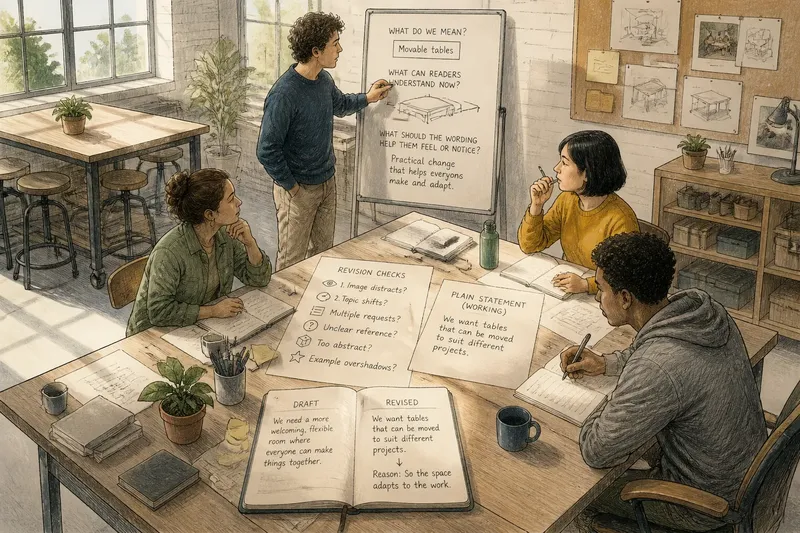
Start with two things you want to bring together, then identify what might happen between them. The link could be a shared pattern, a disagreement, a reversal or a new point of view. Write that relationship in one plain sentence before refining the work.
- Check the connection: If you can name a tension or shared pattern, develop it; if you can only name a surface resemblance, look for a deeper link or choose different ingredients.
- Check the interaction: If changing one ingredient changes how the other is understood, keep developing the pairing; if not, alter their order, form or context.
- Check the audience’s route in: If a newcomer can follow the main feeling or question, retain the current cues; if not, add a clear clue or reduce reliance on obscure references.
- Check who leads: If one ingredient controls every layer, give the quieter one influence over voice, sequence or tone; if neither has a distinct role, remove one.
- Check each retained detail: If a detail supports the relationship, keep it; if it distracts from that connection, cut it.
- Check what the pairing makes possible: If it creates a fresh question or experience, refine that effect; if it only looks unusual, rework the relationship or set the pairing aside.
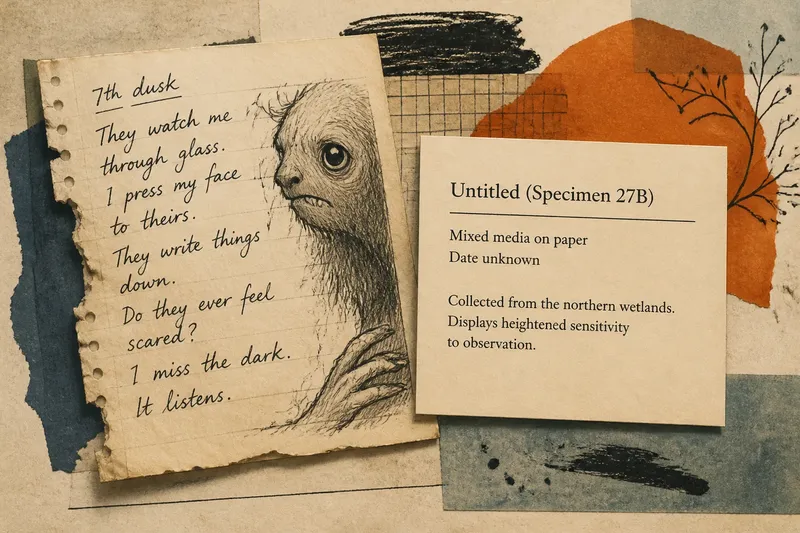
Imagine you have a draft for an invented museum poster: a calm exhibit label sits beside a diary entry from an imaginary monster. In the starting version, both pieces use the same neutral voice, so they read like unrelated blocks. You rewrite the diary in an anxious first-person voice and keep the label restrained; now the contrast makes the monster seem vulnerable while the institution sounds detached. A viewer can follow that tension without knowing any outside reference. The trade-off is clear: the poster gives up some visual quiet to make the voices distinct.
What should you do when a combination feels forced?
A pairing can begin with a coincidence—a matching colour, phrase or shape—and still lead somewhere useful. Ask what that resemblance means in each ingredient. Two things described as fragile, for instance, might differ because one can break physically while the other depends on trust. Their difference may be more interesting than their shared word.
If the work feels crowded, select the features that carry the relationship and let the rest go. There is no need to preserve every characteristic of every source. A single shape, voice or rule may be enough to make the new connection legible.
If you cannot explain what changes when the ingredients meet, try a different pairing rather than adding another element.
Which questions help diagnose a weak combination?
Can unrelated ingredients still work together?
Yes, if the audience can perceive a relationship such as a shared pattern or a clash of tone. The connection need not be obvious at first, but the work should give people something to follow.
Does the audience need to recognise both sources?
No. Recognition can add another layer, but the combination should still offer a clear feeling, question or experience to someone unfamiliar with its ingredients.
When should you remove an ingredient?
Remove it if the work loses no meaning or energy without it. If it contributes a distinct effect, give that effect a clear role rather than keeping it only as a reference.
How much of a source should you keep?
Keep the details that support the new relationship, such as a rhythm, voice, texture or story rule. Let go of details that survive only because they were present in the original.
How can the mash-up’s varied forms guide your next draft?
Collage offers arrangement, retelling offers a changed point of view, and musical mash-ups offer interaction between recognisable elements. These are different creative possibilities, not a single history or recipe. The useful common thread is that form and context can make familiar material do different work.
When you return to a stalled idea, change one relationship before adding more ingredients. Move an element, give a quieter voice control of a scene, or rewrite the sentence that explains the tension. A small, deliberate alteration can show whether the combination has become an idea of its own.